ARPANET
A suite of five audio instruments built from the original nodes of the first packet-switched network.
In the late evening of 29 October 1969, Charley Kline at the University of California at Los Angeles tried to type LOGIN to a host computer 350 miles north at the Stanford Research Institute. The L arrived. The O arrived. The G crashed the receiving system. The first message ever transmitted between two computers on a packet-switched network was therefore "LO" — a fact whose accidental poetry has outlasted the protocol that carried it.
The ARPANET Suite recreates the original five nodes of that network as five distinct audio instruments. Each instrument is named, skinned, and engineered around the actual host computer at the actual institution that joined ARPANET in 1969. The audio role assigned to each instrument is not arbitrary: each does the work that its university actually did on the network. UCLA measured and transmitted; the Suite's UCLA node is the active synthesizer. SRI catalogued information; its node is a convolution reverb that catalogues spaces. UCSB ran on-line mathematics; its node is a tube saturator whose modes are mathematical functions. Utah translated curves into surfaces; its node is a waveshaper. BBN built the routers; its node is the master bus through which the others flow.
This is the documentation of that mapping, the people behind it, and the pledge that accompanies its release.
The network in 1969
The ARPANET began as a modest experiment in packet-switched communication. The Advanced Research Projects Agency — ARPA, today DARPA — awarded contract DAHC15-69-C-0285 to Bolt Beranek and Newman of Cambridge, Massachusetts, to build the first four Interface Message Processors (IMPs) for a four-node experimental network. The contract director was Lawrence G. Roberts. The four host institutions had been chosen on the basis of their existing ARPA-sponsored research: the University of California at Los Angeles, the Stanford Research Institute, the University of California at Santa Barbara, and the University of Utah. Each ran a different host computer; each had a different research role; each would, over the following decade, contribute foundational technology to what became the modern internet.
By December 1969 the network was operational across the original four sites. Through 1970 the experimental network grew: BBN itself joined as a fifth node, and within five years ARPANET would span the continental United States. But the original five — UCLA, SRI, UCSB, Utah, and BBN — are the founders. The Suite honours those five, and only those five.
The remainder of this document describes each node in turn: the institution, the host computer, the people, the role on the network, and the audio instrument that bears its name in the Suite.
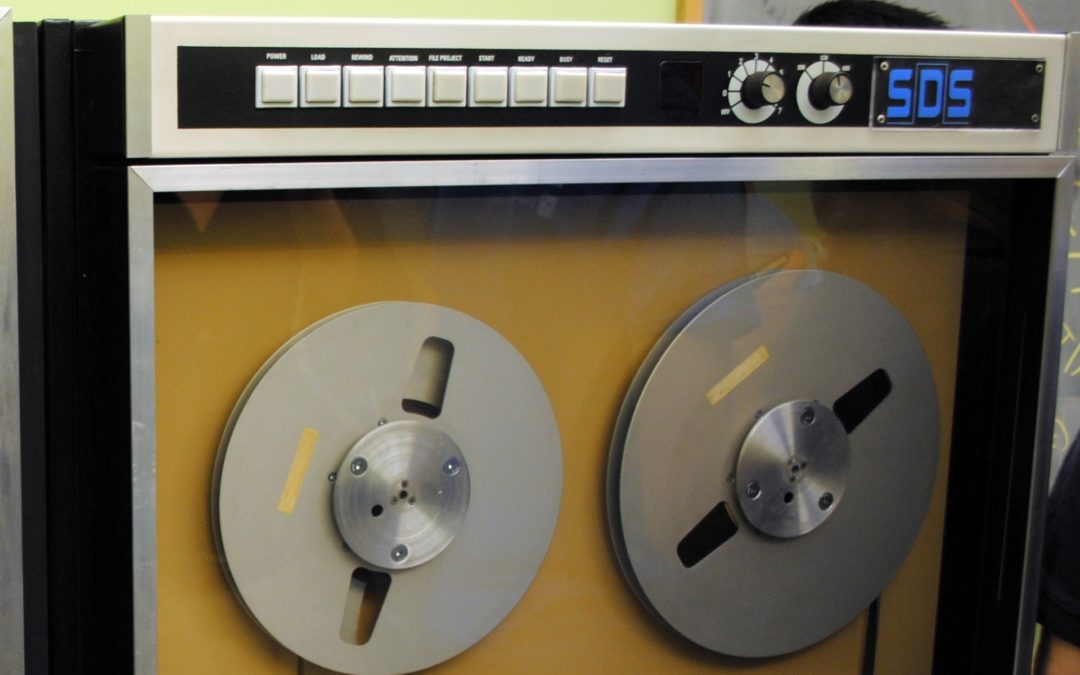
UCLA · SDS Sigma 7 · Network Measurement Center
UCLA hosted the Network Measurement Center (NMC) under the direction of Leonard Kleinrock, whose 1962 doctoral thesis at MIT — Information Flow in Large Communication Nets — established much of the mathematical framework for packet-switched communication. The host computer was a Scientific Data Systems Sigma 7: an early 32-bit machine with 32K words of magnetic-core memory, manufactured at SDS's plant in El Segundo, California. The Sigma 7's institutional role on ARPANET was diagnostic. It measured the network: latency, throughput, packet loss, queue depth.
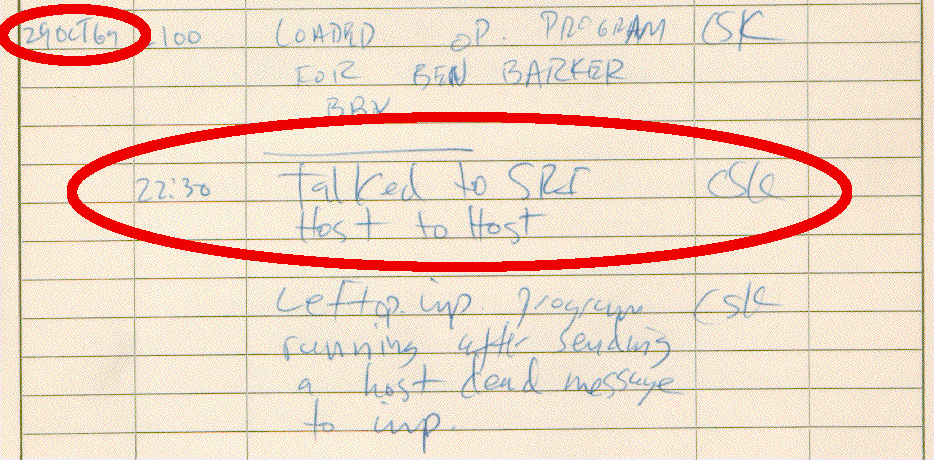
The first IMP arrived at Boelter Hall on 30 August 1969. Eight weeks later, on 29 October at 22:30 Pacific Standard Time, Charley Kline, a graduate student in Kleinrock's group, sat at a Teletype Model 37 terminal in room 3420 and attempted to log in to the SRI host. He typed L, then O, and on the G the SRI host crashed. The transmission and crash, recorded above, are the reason any of this matters. Both Kline (at UCLA) and Bill Duvall (at SRI) confirmed the receipt of the L and O by telephone after the fact — a moment of bidirectional communication preserved entirely in pencil and paper-tape logs.
"LO."The first packet, transmitted UCLA → SRI, 29 October 1969, 22:30 PST.
In the ARPANET Suite, Node 1 SDS Sigma 7 is the synthesizer. The function maps cleanly: UCLA's NMC was the active transmitter on the network, the source of measurement traffic; the synthesizer in the Suite is the active sound source that drives the rest of the chain. Voice generation, pattern sequencing (a sixteen-step paper-tape programmer modelled on the actual paper-tape input device of the period), the modulation matrix (routed through the BBN-1822 protocol), and a twenty-five-key Bakelite keyboard housed in a slide-out operator console drawer all live in this instrument. Cold start is signed by a recreation of the LO transmission itself, played on a Tektronix 611 phosphor display.
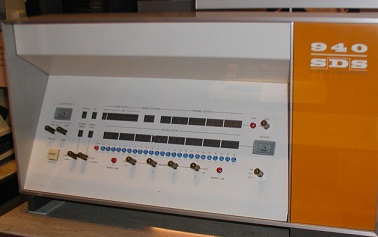
SRI · SDS 940 · Network Information Center / NLS
The Stanford Research Institute hosted the Network Information Center (NIC) under Douglas Engelbart's Augmentation Research Center. The host was an SDS 940, a 24-bit time-sharing computer that ran NLS — the oN-Line System — Engelbart's hierarchical, hyperlinked, mouse-and-keyset-driven environment that prefigured nearly every conceptual move of the modern personal computer.
NLS was demonstrated publicly on 9 December 1968, eleven months before ARPANET came online, in what is now universally called The Mother of All Demos. Engelbart, on stage at the Brooks Hall Convention Center in San Francisco, accessed his SRI-hosted NLS system over a leased line, manipulated text in real time using a mouse he had invented, switched between video feeds from two locations, demonstrated hypertext links, real-time collaborative editing, and screen sharing, and delivered a 90-minute presentation of every concept that would, twenty-five years later, be marketed to the general public as the internet. The complete demonstration is available in the Stanford archives.
When the network came online in October 1969, SRI's role was the information catalogue — to host the documents, drafts, and operational records of ARPANET itself, including the Request-for-Comments series that codified its protocols.
In the Suite, Node 2 SRI-940 Spring is the convolution reverb. The function maps directly: NLS catalogued information in retrievable form; the convolution reverb is a catalogue of spaces. Twelve impulse responses ship with the instrument: Engelbart's actual SRI office (Menlo Park, 1968, 2.1 s reverb time), Oxford Union Hall (Debate Chamber, 1823, 3.6 s), Cambridge Trinity College Commons (1685, 4.2 s), the Bell Labs anechoic chamber at Murray Hill (0.0 s), the Arecibo radio dish (305 m, 7.5 s), the Mt Wilson 100-inch dome (Pasadena, 1917, 2.8 s), Kennedy Space Center Vehicle Assembly Building Bay 1 (160 m, 10 s), the King's Chamber of the Great Pyramid of Giza (c. 2560 BC, 4.0 s), Stanford Memorial Church (Palo Alto, 1903, 5.4 s), Harrison's Cave in Barbados (limestone, 6.2 s), the 14th Street tunnel of the Manhattan subway (1.0 s), and KSC VAB Bay 1. The Engelbart five-key chord keyset, his one-handed input device of 1968, becomes the trigger panel.
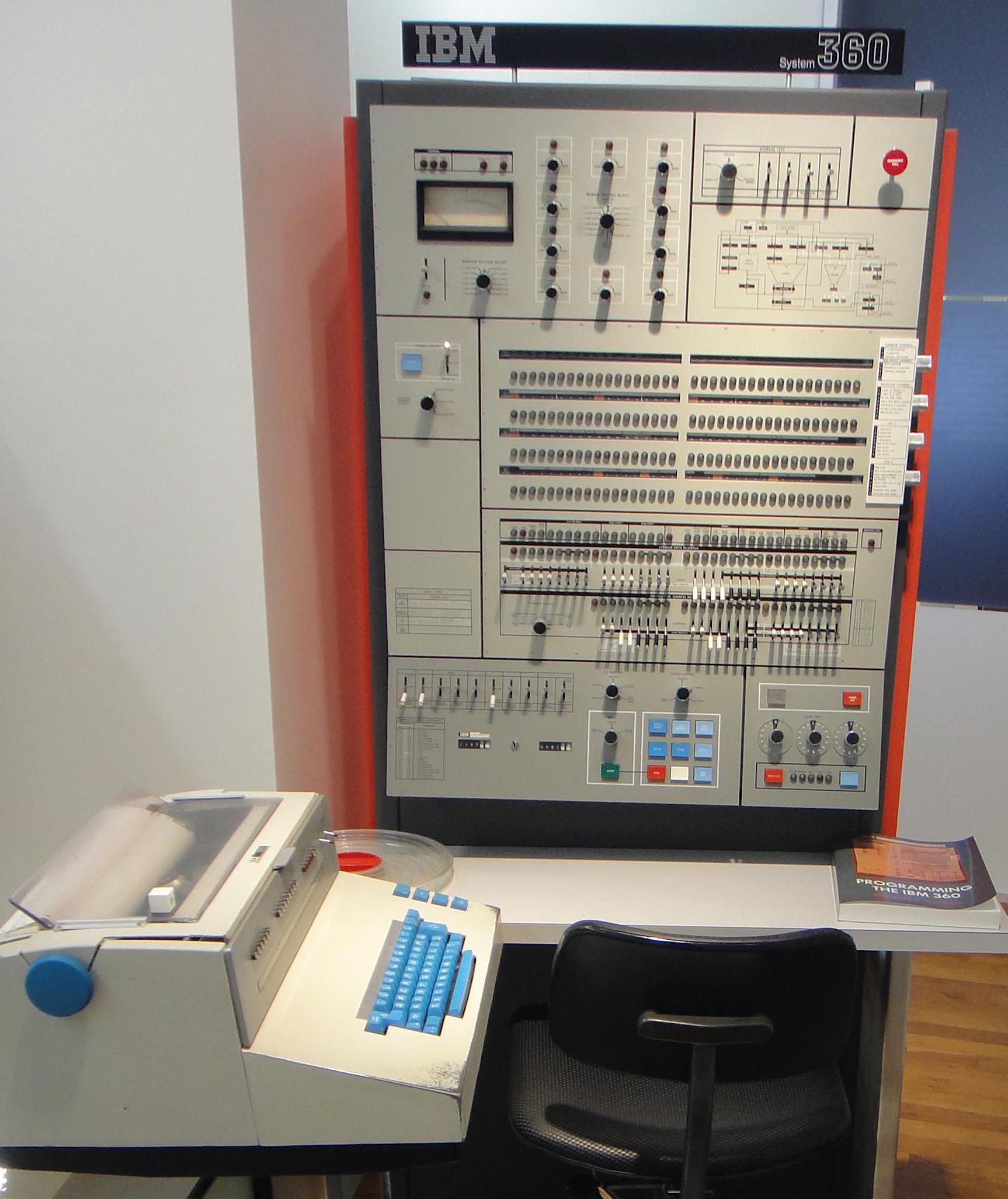
UCSB · IBM 360/75 · Culler-Fried On-Line
The University of California at Santa Barbara hosted the Culler-Fried On-Line System, developed by Glen J. Culler and Burton D. Fried in the Mathematics Department. The host was an IBM System/360 Model 75 — a heavy mainframe of the period, manufactured at IBM's Goleta, California facility (a few miles up the coast from the UCSB campus). The Culler-Fried system gave mathematicians the ability to interact with their calculations in real time, using a custom CRT display and light pen. This was a remarkable achievement at a moment when most computing was batch-processed via punch cards and printer output.
Among the calculations supported on-line: numerical integration, Fourier series and FFTs, matrix operations including LU decomposition, root-finding, eigenvalue solutions, and symbolic computation. The system shipped with a hand-trained interactive graphical interface that pre-dated similar capabilities at MIT's Project MAC by several years.
In the Suite, Node 3 UCSB-360 is the tube saturator. The function maps through the institutional role: UCSB's contribution was applied mathematical functions on-line, and the saturator's character is shaped by exactly such functions. The saturation modes are named OL-1, OL-2, INT, DIF, SQR, SQRT, LOG, EXP, SIN, TAN. The chassis features dual RCA 12AX7 / ECC83 twin-triode vacuum tubes (rendered with period-correct filament glow), an Ampex 354 tape compressor running at 7.5 IPS, and a Pultec EQP-1A master EQ — the audio gold-standard hardware of the era. The Culler-Fried light pen probes the saturation transfer curve and reads back 2nd and 3rd harmonic content live on a vector-scope display.
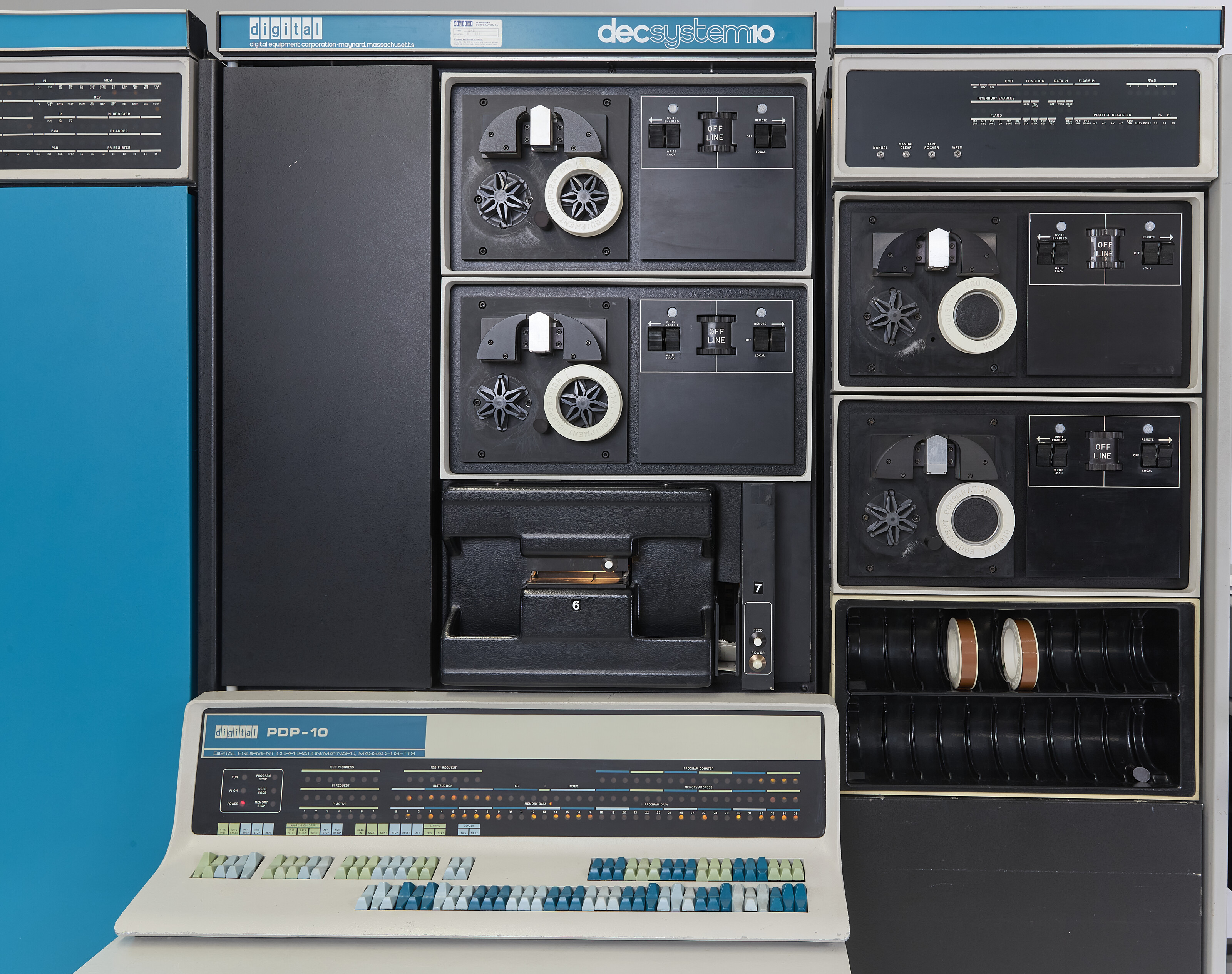
Utah · PDP-10 · Sutherland Computer Graphics Laboratory
The University of Utah hosted the laboratory of Ivan E. Sutherland and David C. Evans, where the foundations of three-dimensional computer graphics were established between 1968 and 1975. The host was a Digital Equipment Corporation PDP-10 (KA-10 processor), the workhorse minicomputer of the academic computing era. The Utah lab is, by reasonable accounting, the single most influential institution in the history of computer graphics.
Among the techniques and primitives invented or refined at Utah during this period: hidden-line removal (Warnock and Watkins), the smooth-shading algorithms that bear Henri Gouraud's and Bui Tuong Phong's names, the Bezier curve as later refined by Edwin Catmull and Jim Clark, the Z-buffer (Catmull, 1974), and the Newell teapot — that small ceramic teapot from a Utah tea service which became, and remains, the canonical 3D test object. The display device was the LDS-1 (later LDS-2), the first commercially produced vector display, paired with a light pen for direct manipulation. Catmull, Clark, and Gouraud, among many others, would go on to found the computer-graphics industry; Catmull and Clark each later founded Pixar and Silicon Graphics respectively.
In the Suite, Node 4 UTAH-10 is the waveshaper. The function maps through the laboratory's character: Utah translated mathematical curves into visual surfaces, and the waveshaper translates mathematical curves into audio surfaces. The waveshape transfer library is built on Chebyshev polynomials — the same orthogonal-basis approach the Utah lab used to fit smooth surfaces over polygon meshes. The LDS-1 vector display in the chassis renders the Newell Teapot in real time as the input audio drives it, and a Sutherland-class light pen probes the waveshape, reading back X, Y, R, and θ coordinates in the same coordinate system Sutherland's Sketchpad used.
BBN · Honeywell DDP-516 · IMP Laboratory
Bolt Beranek and Newman of Cambridge, Massachusetts — today known as Raytheon BBN — built the network itself. The IMP, the Interface Message Processor, was the BBN-engineered packet router that sat between each host computer and the leased telephone line connecting it to the network. The hardware was a Honeywell DDP-516 minicomputer, ruggedised and modified to handle 50 kbps long-line traffic over the BBN-1822 protocol. Each IMP was the size of a refrigerator, weighed about 900 pounds, and operated at the (then-considerable) clock rate of 0.96 MHz. The first IMP serial number is 1822-0001.
The BBN team that built the IMPs included Frank Heart (project lead), Robert Kahn (later co-inventor of TCP/IP with Vinton Cerf), Severo Ornstein, Dave Walden, William Crowther, Bernie Cosell, and Ben Barker. Robert Kahn later moved to ARPA and, with Vinton Cerf at Stanford, drafted the specifications that became the modern internet protocols TCP and IP. Lawrence Roberts, the ARPA program manager who awarded the original contract, later served as president of Telenet, the first commercial packet-switched data carrier.
In the Suite, Node 5 BBN Master is the master bus. The function maps inevitably: BBN's role was to route packets between nodes, and the master bus's role is to route audio between nodes. The signal flow of the Suite goes UCLA (synthesis) → UCSB (saturation) → UTAH (waveshaping) → SRI (reverb) → BBN (master glue, tape, EQ, imaging, transient shaping). The chassis includes a Pultec EQP-1A master EQ, an AMPEX 350 tape stage at 7.5 IPS, a Tektronix 611 spectrum analyzer, and an M/S Lissajous goniometer. BBN's corporate logo is a bee. The bee remains on the Master Bus's nameplate — and on the suite as a whole.
The technical architecture of the Suite
Each instrument shares a common engine but is tuned and skinned to its node. The engine ships with forty-six voice synthesis modes (frequency-modulation, additive, physical-modelling, plucked, vocal, field-recording-style), ten thematic banks of fifteen presets each — one hundred and fifty named patches per node, every one drawn from real ARPANET history (CERF, BARAN, KAHN, ROBERTS, KLEINROCK, RFC·1, MOTHER·DEMO, SAGE, TENEX, and so on). The sequencer is polyrhythmic, with rates including triplets and 5:4 / 7:8 polyrhythms; the modulation matrix routes four sources to six destinations through what we call a BBN-1822 routing matrix — the comms protocol becomes the modulation protocol.
Patches and banks are portable across nodes via the open .UCL file format — named for UCLA, the first node, where every transmission begins. Sound designers can author their own banks; the format specification is distributed alongside each instrument.
On the bee
The bee that appears at the head of this report — and on the chassis of Node 5 BBN Master, and on the merchandise associated with this Suite — has two ancestries.
The first is corporate. Bolt Beranek and Newman, the Cambridge firm that built the original IMPs, has carried a stylised bee as its company mark for most of its history. The acronym BBN phonetically suggests the verb to be and visually suggested the insect; the company's employees became, by long convention, "the BBN bees." Choosing the bee as the mascot for this Suite is therefore historically literal: the bee is BBN, BBN built ARPANET, the Suite is built from ARPANET.
The second is ethical. Honey bees, native solitary bees, and other pollinator species are in measurable decline across most of the temperate world, owing principally to pesticide exposure (notably neonicotinoids), habitat loss, parasitic mites and viruses, and climate stress. Pollinator services support an estimated one-third of the global food supply; their collapse is a quiet crisis whose costs are not yet fully recognised in policy.
Candidate recipients under consideration include the Xerces Society for Invertebrate Conservation, the Pollinator Partnership, the Bee Conservation Trust, and local hive-keeping mutual-aid networks. The full list of recipient organisations and the annual donation total will be disclosed publicly each calendar year. This is not a marketing flourish. It is a standing commitment.
"Bees are precious to all of our survival and they're threatened."T. A. Cunningham · Founder · April 2026
The people we honour
This Suite would not exist without the work of the engineers, scientists, and graduate students whose names are listed below. Each contributed materially to the technologies the Suite recreates. Where a person was associated with more than one node, only the primary association is listed.
Notes & primary sources
- Kleinrock, L. Information Flow in Large Communication Nets. MIT doctoral dissertation, 1962.
- Roberts, L. G. & Wessler, B. D. Computer Network Development to Achieve Resource Sharing. Spring Joint Computer Conference, 1970.
- Heart, F., Kahn, R., Ornstein, S., Crowther, W. & Walden, D. The Interface Message Processor for the ARPA Computer Network. Spring Joint Computer Conference, 1970.
- Cerf, V. & Kahn, R. A Protocol for Packet Network Intercommunication. IEEE Transactions on Communications, vol. COM-22, no. 5, May 1974.
- Engelbart, D. C. The Mother of All Demos, Brooks Hall Convention Center, San Francisco, 9 December 1968. Stanford Library archive available online.
- Crocker, S. RFC 1: Host Software. 7 April 1969.
- Sutherland, I. E. Sketchpad: A Man-Machine Graphical Communication System. MIT doctoral dissertation, 1963.
- Catmull, E. A Subdivision Algorithm for Computer Display of Curved Surfaces. University of Utah doctoral dissertation, 1974.
- Charley Kline's IMP log, 29 October 1969, UCLA Boelter Hall room 3420. UCLA Special Collections.
- BBN Technologies. Corporate archives (Cambridge, Massachusetts), 1948–present.
- Bee population studies: Goulson, D. et al. Bee declines driven by combined stress from parasites, pesticides, and lack of flowers. Science 347:6229, 2015.
- IEEE Spectrum. Building the System/360 Mainframe Nearly Destroyed IBM. spectrum.ieee.org. Source for the $5 billion S/360 development figure cited in §IV.a; covers the financing, debt-issuance, and management upheaval that followed the bet.
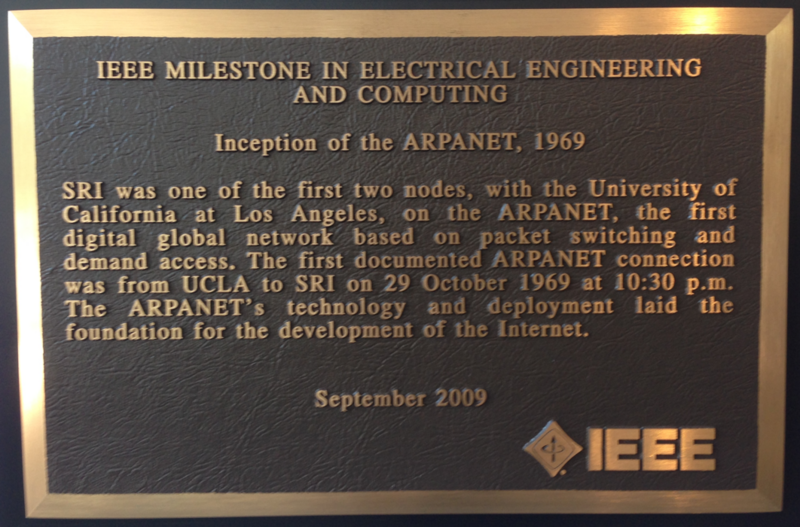
- IEEE Milestones in Electrical Engineering and Computing. Inception of the ARPANET, 1969. Bronze plaque dedicated September 2009, mounted at SRI International, Menlo Park, California. The IEEE Milestone program recognizes achievements of lasting significance to humanity; the plaque records the first host-to-host packet transmission between UCLA and SRI on 29 October 1969 and credits BBN's Interface Message Processor as the enabling hardware.